Hands down- retinoids are the best drugs for acne. There is no better class of drugs that can erase acne like the retinoids. The majority of individuals do respond to retinoids; a few individuals may not. In these individuals, combination therapy with other drugs may be required
The majority of vitamin A derived products are good for acne. Retinoids are vitamin A derived drugs that have been around for more than 20 years.
Retinoids are not the first drugs for acne. A lot of studies exist which show the benefits of these drugs for acne sufferers. Retinoids are frequently used to treat moderate to severe cases of acne. Retinoids act by decreasing black heads and stopping the production of sebum or excess oil. Retinoids are available either as a pill or a topical lotion.
Retinoids are very potent drugs and besides acne, can help erase fine lines, and dry up oily skin. Because the drugs can cause excess drying and skin peeling, their use must be closely monitored. Retinoids should not be taken by females who intend to get pregnant or are breast feeding.
If you fail to respond to a retinoid, chances are you will not respond to any other drug.
Showing posts with label acne scars. Show all posts
Showing posts with label acne scars. Show all posts
Tuesday, March 2, 2010


Sunday, June 14, 2009
Why do i have acne: part 3
How does one get rid of acne scars?
If you think acne is a real hassle, then acne scars can be a real pain in the arse.
In the last few years, lasers have been developed which can help reduce acne scars. Lasers are never the first choice for acne and only used after other treatments have been tried out. Most physicians use lasers in combination with drugs to cure the resistant inflammatory acne outbreaks. The results after laser for acne scars are mediocre at best. Most of the time, you end up wasting thousands of dollars and end up with a face which looks a lot worse than what you previously had.
Finally there are a number of chemical peels which are available to treat acne. Glycolic acid is probably the best as it is gentler to the skin. However, chemical peels like laser are an adjunct to medicines for the treatment of acne. Results after chemical peels for acne scars are terrible.
Final point
So in the end, be a wise consumer, read about acne and the available treatments. Do not always stand in a queue for the latest treatment and never fall the pre and post photo routine. The majority of treatments are nothing more than a scam. Medicine is first of all a business and many health professional care more about money than your skin. Always check up the credentials of your provider, ask questions, and if in doubt get a second opinion.
If you think acne is a real hassle, then acne scars can be a real pain in the arse.
In the last few years, lasers have been developed which can help reduce acne scars. Lasers are never the first choice for acne and only used after other treatments have been tried out. Most physicians use lasers in combination with drugs to cure the resistant inflammatory acne outbreaks. The results after laser for acne scars are mediocre at best. Most of the time, you end up wasting thousands of dollars and end up with a face which looks a lot worse than what you previously had.
Finally there are a number of chemical peels which are available to treat acne. Glycolic acid is probably the best as it is gentler to the skin. However, chemical peels like laser are an adjunct to medicines for the treatment of acne. Results after chemical peels for acne scars are terrible.
Final point
So in the end, be a wise consumer, read about acne and the available treatments. Do not always stand in a queue for the latest treatment and never fall the pre and post photo routine. The majority of treatments are nothing more than a scam. Medicine is first of all a business and many health professional care more about money than your skin. Always check up the credentials of your provider, ask questions, and if in doubt get a second opinion.
Wednesday, May 20, 2009
Acne Facials- another crappy treatment?
For teenagers and young adults, there is no condition that is more agonizing than facial acne. Facial acne can make a mess of one’s personal life. It is an embarrassing skin disorder that often leads to isolation, withdrawal, and depression. Why acne happens in a few individuals and not in others is not really known. In general, acne is more common in men than in women.
Why does acne occur?
Acne occurs when skin pores get plugged with excess oil, debris, or dirt. When pores get blocked, this leads to small pimple formation. Once the bacteria start to grow in the oils, this leads to redness and tender pustules that appear “angry”. Acne sucks- there is nothing nice to say about this skin ailment.
Is there any treatment for facial acne?
The majority of over the counter medications and antibiotics rarely help and may in fact worsen acne in some cases. In many cases, medications cause skin dryness, worsen redness, and make the skin look like crap. Moreover, acne medications do not come cheap. For decades, there were no options for acne sufferers. Now we have acne facials
Why does acne occur?
Acne occurs when skin pores get plugged with excess oil, debris, or dirt. When pores get blocked, this leads to small pimple formation. Once the bacteria start to grow in the oils, this leads to redness and tender pustules that appear “angry”. Acne sucks- there is nothing nice to say about this skin ailment.
Is there any treatment for facial acne?
The majority of over the counter medications and antibiotics rarely help and may in fact worsen acne in some cases. In many cases, medications cause skin dryness, worsen redness, and make the skin look like crap. Moreover, acne medications do not come cheap. For decades, there were no options for acne sufferers. Now we have acne facials
Monday, April 27, 2009
Dermabrasion & Acne scars- Part 2
How many sessions are required?
Almost everyone requires 4-6 sessions depending on type of acne scar, skin, and response.
How is dermabrasion performed?
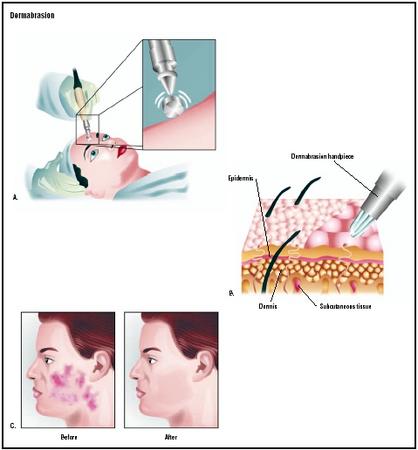
The procedure involves use of a device that rotates (just like a sand paper device). The device rotates fast and removes top layer of skin. The treatment does hurt or sting and thus, the physician will apply a cold ice pack or a topical local anesthetic on skin 20 minutes before the procedure. Once your face is clean and dry, the high-speed rotating device is held close to the skin. The spinning action removes all uneven skin imperfections and irregularities. After dermabrasion is completed, a topical antibiotic is applied and the area is covered with a moist dressing.
What happens after the procedure?
Immediately after Dermabrasion, the skin appears as if you have had moderate or intense sunburn. The skin may look raw, blistered, swollen, bruised, and very red. There definitely is pain after the procedure that may vary from mild to moderate. However, pain is easily controlled with over the counter pain medications. For the next few days, one may need to change the dressings once or twice a day. Daily application of an antibiotic ointment is also recommended
When does one see results after dermabrasion?
The results are never immediate. In most individuals, the early results are seen after 10-18 days. During the first few days after the procedure, skin will appear raw and pink. The pink skin is then slowly replaced by fresh new skin over the next 6-12 weeks. The pink or red skin can be hidden with use of camouflage or make-up creams.
It is vital that one avoid sun exposure after dermabrasion. If one goes out, a sunscreen is a must. Exposure to sun can cause intense darkening of skin, that can be irreversible
Almost everyone requires 4-6 sessions depending on type of acne scar, skin, and response.
How is dermabrasion performed?
The procedure involves use of a device that rotates (just like a sand paper device). The device rotates fast and removes top layer of skin. The treatment does hurt or sting and thus, the physician will apply a cold ice pack or a topical local anesthetic on skin 20 minutes before the procedure. Once your face is clean and dry, the high-speed rotating device is held close to the skin. The spinning action removes all uneven skin imperfections and irregularities. After dermabrasion is completed, a topical antibiotic is applied and the area is covered with a moist dressing.
What happens after the procedure?
Immediately after Dermabrasion, the skin appears as if you have had moderate or intense sunburn. The skin may look raw, blistered, swollen, bruised, and very red. There definitely is pain after the procedure that may vary from mild to moderate. However, pain is easily controlled with over the counter pain medications. For the next few days, one may need to change the dressings once or twice a day. Daily application of an antibiotic ointment is also recommended
When does one see results after dermabrasion?
The results are never immediate. In most individuals, the early results are seen after 10-18 days. During the first few days after the procedure, skin will appear raw and pink. The pink skin is then slowly replaced by fresh new skin over the next 6-12 weeks. The pink or red skin can be hidden with use of camouflage or make-up creams.
It is vital that one avoid sun exposure after dermabrasion. If one goes out, a sunscreen is a must. Exposure to sun can cause intense darkening of skin, that can be irreversible
Dermabrasion & Acne scars- Part 1
Today, individuals who have acne scars have several treatment options, none of them great. The type of treatment generally depends on type of scar, skin type and how much you want to spend. One of the available and affordable treatments for acne scars is dermabrasion. Dermabrasion is basically a procedure which “sands” your skin. The dermabrasion device rotates at high speeds and shaves off the very superficial skin layers, thus removing all dead skin and debris. When the process is repeated many times, the area is eventually replaced with smooth, fresh, and younger looking skin (at least this is what it says in the books).
All consumers should not fall into the trap of looking at pre and post photos about patients. Medicine like cyberspace is an illusion- everything can look real but in fact there are a lot of false promises. This is more true of cosmetic practice than any other discipline in all of medicine
Dermabrasion should not be confused with Microdermabrasion that is a much gentler skin polish, is expensive, and does absolutely nothing for acne scars (or for that matter any skin disorder). Dermabrasion is not a one shot deal, requires time to perform, is also expensive, hurts and there are several days of downtime.
Where is dermabrasion done?
Dermabrasion is a clinic/spa based procedure and does not require use of any general anesthesia. The procedure does not entail use of needles and it is not extremely painful but does sting.
Who can undergo dermabrasion?
Anyone with acne scars can undergo dermabrasion but one also has to be realistic. Even though dermabrasion has been around for more than 20 years, the results are not always great. There are countless testimonials on the negative aspect of this treatment, but for individuals with acne scars, there is sometimes little choice. Dermabrasion only produces decent results in soft superficial scars.
The results after dermabrasion are not immediate. Most individuals require several treatments and one NEVER ever regains the soft, smooth, young, looking skin. Dermabrasion does make an improvement in skin but the results are variable, not reproducible and can also make your skin condition worse in some cases (hard facts which no one ever tells you)
All consumers should not fall into the trap of looking at pre and post photos about patients. Medicine like cyberspace is an illusion- everything can look real but in fact there are a lot of false promises. This is more true of cosmetic practice than any other discipline in all of medicine
Dermabrasion should not be confused with Microdermabrasion that is a much gentler skin polish, is expensive, and does absolutely nothing for acne scars (or for that matter any skin disorder). Dermabrasion is not a one shot deal, requires time to perform, is also expensive, hurts and there are several days of downtime.
Where is dermabrasion done?
Dermabrasion is a clinic/spa based procedure and does not require use of any general anesthesia. The procedure does not entail use of needles and it is not extremely painful but does sting.
Who can undergo dermabrasion?
Anyone with acne scars can undergo dermabrasion but one also has to be realistic. Even though dermabrasion has been around for more than 20 years, the results are not always great. There are countless testimonials on the negative aspect of this treatment, but for individuals with acne scars, there is sometimes little choice. Dermabrasion only produces decent results in soft superficial scars.
The results after dermabrasion are not immediate. Most individuals require several treatments and one NEVER ever regains the soft, smooth, young, looking skin. Dermabrasion does make an improvement in skin but the results are variable, not reproducible and can also make your skin condition worse in some cases (hard facts which no one ever tells you)
Microdermabrasion and Acne scars
Acne scars are extremely unpleasant and are very difficult to treat. Despite all the novel treatments and weekly hyped up statements made by health care workers, nothing seems to work well for acne scars. Over the past 20 years, many treatments have come and gone for acne scars and the latest is Microdermabrasion. There is a lot written about Microdermabrasion and how great it is. All cosmetic physicians and surgeons make it sound like Microdermabrasion is a cure for every type of skin disorder, including acne scars. There are hundreds of pre and post photos of individuals who have undergone Microdermabrasion- each post treatment photo showing beautiful young skin. So the question everyone with acne wants to know, “is Microdermabrasion a great treatment for Acne Scars?”
What is Microdermabrasion?
Microdermabrasion is a simple technique that uses a small hand held device that basically polishes the skin. The small device is held close to the skin. Inside the device are some small tiny crystals that spin at high speed. The spinning action of crystals removes the dirt and dead skin cells. Many new devices also have a vacuum attached which suctions off all the debris. The treatment is gentle, does not hurt at all, and can be done within 10-20 minutes.
Can Microdermabrasion erase acne scars?
If you speak to the doctors, each and everyone will say it is a great treatment. In reality, Microdermabrasion is probably the biggest scam in all of cosmetic surgery. It does absolutely nothing. Not only will you waste your time but you will also spend a lot of your hard-earned money on a worth less treatment. There is not a single person in this universe that has ever benefited from this rubbish treatment. Microdermabrasion is only a polish for skin. You can use a vibrator to do the same thing.
Acne scars are deep and need more intense treatments. Microdermabrasion is not a treatment for acne scars and anyone who makes such a claim is an outright FRAUD. You can polish your skin for the next 100 years; the only thing you will ever erase is your bank balance. The polish will make your skin look fresh and young for 2 hours, but that is all you will ever achieve.
What is Microdermabrasion?
Microdermabrasion is a simple technique that uses a small hand held device that basically polishes the skin. The small device is held close to the skin. Inside the device are some small tiny crystals that spin at high speed. The spinning action of crystals removes the dirt and dead skin cells. Many new devices also have a vacuum attached which suctions off all the debris. The treatment is gentle, does not hurt at all, and can be done within 10-20 minutes.
Can Microdermabrasion erase acne scars?
If you speak to the doctors, each and everyone will say it is a great treatment. In reality, Microdermabrasion is probably the biggest scam in all of cosmetic surgery. It does absolutely nothing. Not only will you waste your time but you will also spend a lot of your hard-earned money on a worth less treatment. There is not a single person in this universe that has ever benefited from this rubbish treatment. Microdermabrasion is only a polish for skin. You can use a vibrator to do the same thing.
Acne scars are deep and need more intense treatments. Microdermabrasion is not a treatment for acne scars and anyone who makes such a claim is an outright FRAUD. You can polish your skin for the next 100 years; the only thing you will ever erase is your bank balance. The polish will make your skin look fresh and young for 2 hours, but that is all you will ever achieve.
Tuesday, April 14, 2009
Lasers and acne scars
Before one plans to have treatment for an acne scar, the acute phase of acne must be treated. Lasers work best on a well-healed scar. If an acne scar is prematurely treated with laser, it can worsen the scar and cause serious discoloration of skin
What type of laser is used to treat acne scars?
Every single day there is a new laser, which is hyped up to be better than the ones used previously. All this tells the consumer is that there is no perfect laser. There are some lasers that cause less damage to surrounding tissue and thus limit the side effects. However, no matter what type of laser is used, there is always a risk of skin discoloration, worsening of scar or failure of laser to work. The most common complication of lasers used to treat acne scars is that the laser frequently fails to give the desired result.
What are non-ablative lasers?
All “non-ablative” means is that the laser is gentler to your skin. The laser beam is more focused and only affects damaged tissue- this is simply a theoretical point of view. Does anyone really believe that a laser beam knows what is normal and abnormal skin tissue? If you pour hot coffee on your hand, will the coffee only affect a certain part of your skin? Hope no one believes this BS jargon. Laser generates heat and this heat can damage both normal and abnormal tissue.
What is the big deal with non ablative?
Just the jargon used by doctors. The non-ablative lasers are non-destructive meaning that they do not cause much damage to normal tissues. Non-ablative is a big word in cosmetic surgery. Some of these lasers are less intense and will not even cause redness of skin from heat. One such non-ablative laser is the pulsed dye laser. It can remove reddish marks from the skin. Since many acne scars are red, the pulse dye laser can help improve the skin quality- in terms of both color and texture.
What type of laser is used to treat acne scars?
Every single day there is a new laser, which is hyped up to be better than the ones used previously. All this tells the consumer is that there is no perfect laser. There are some lasers that cause less damage to surrounding tissue and thus limit the side effects. However, no matter what type of laser is used, there is always a risk of skin discoloration, worsening of scar or failure of laser to work. The most common complication of lasers used to treat acne scars is that the laser frequently fails to give the desired result.
What are non-ablative lasers?
All “non-ablative” means is that the laser is gentler to your skin. The laser beam is more focused and only affects damaged tissue- this is simply a theoretical point of view. Does anyone really believe that a laser beam knows what is normal and abnormal skin tissue? If you pour hot coffee on your hand, will the coffee only affect a certain part of your skin? Hope no one believes this BS jargon. Laser generates heat and this heat can damage both normal and abnormal tissue.
What is the big deal with non ablative?
Just the jargon used by doctors. The non-ablative lasers are non-destructive meaning that they do not cause much damage to normal tissues. Non-ablative is a big word in cosmetic surgery. Some of these lasers are less intense and will not even cause redness of skin from heat. One such non-ablative laser is the pulsed dye laser. It can remove reddish marks from the skin. Since many acne scars are red, the pulse dye laser can help improve the skin quality- in terms of both color and texture.
Monday, April 13, 2009
Acne Scarring 101 part 2
Acne scars do not only occur on face but also on neck, upper arms, shoulders, and chest. It is difficult to know who will develop acne scars. In many cases, acne scars develop and generally resolve spontaneously.
There is one observation about acne scars, - individuals who develop the inflammatory type acne, those who muck around with mechanical devices to squeeze the pimples or those use harsh chemicals are prone to scars.
The only good things about acne scars is that unlike the past, we do know more about it today and there arse also some good treatments.. Fact one- there is no ideal treatment for acne and fact 2, no presently available treatment works in everyone. All the available treatments work to some degree but you will never get your beautiful, smooth, soft skin back. There are a lot of physicians and health care workers who hype up lasers and dermal fillers as great treatment for acne. Sure, these treatments work but only in some individuals and not everyone gets the desired result. Some cosmetic physicians do have a tendency to exaggerate things (some call it lying), just like car mechanics.
For all individuals with acne scars, there are some decent treatments available that can help improve aesthetics of your face, the most difficult part is finding a physician who excels at these treatments. Treatment of acne scars requires an excellent physician who knows what is going on and is truly interested in helping your skin then filling his/her pockets with your heard earned money.
So before you go rushing for the latest laser treatment, talk to people, get referrals, read about the disorder, ask questions and above all choose your provider well. Acne treatment is not a cheap undertaking. The amount of money you will pay for acne scar treatments is just about the same as putting a down payment on a decent car/house. Times are tough today- be wise and go slow. If ever in doubt, get a second opinion.
There is one observation about acne scars, - individuals who develop the inflammatory type acne, those who muck around with mechanical devices to squeeze the pimples or those use harsh chemicals are prone to scars.
The only good things about acne scars is that unlike the past, we do know more about it today and there arse also some good treatments.. Fact one- there is no ideal treatment for acne and fact 2, no presently available treatment works in everyone. All the available treatments work to some degree but you will never get your beautiful, smooth, soft skin back. There are a lot of physicians and health care workers who hype up lasers and dermal fillers as great treatment for acne. Sure, these treatments work but only in some individuals and not everyone gets the desired result. Some cosmetic physicians do have a tendency to exaggerate things (some call it lying), just like car mechanics.
For all individuals with acne scars, there are some decent treatments available that can help improve aesthetics of your face, the most difficult part is finding a physician who excels at these treatments. Treatment of acne scars requires an excellent physician who knows what is going on and is truly interested in helping your skin then filling his/her pockets with your heard earned money.
So before you go rushing for the latest laser treatment, talk to people, get referrals, read about the disorder, ask questions and above all choose your provider well. Acne treatment is not a cheap undertaking. The amount of money you will pay for acne scar treatments is just about the same as putting a down payment on a decent car/house. Times are tough today- be wise and go slow. If ever in doubt, get a second opinion.
Acne Scarring 101
Acne is a very upsetting skin disorder but what is worse is the development of acne scars. Many individuals develop acne and then it disappears without any hassles. However, a number of other individuals (the unlucky ones) develop acne and it leaves the face with ugly scars. Why one person develops acne scars and others do not know is not fully understood. Acne scars are never nice and can severely compromise beauty of the face.
Whenever injury occurs to the skin, the body attempts to repair the damage. The healing process goes quite smooth in most cases, but often the body does crazy things and scars develop. Whenever the balance between healing and repair is altered, acne scars occur. In general, scars occur because of too much healing by the body.
African Americans and individuals with dark skin often develop evidence of exaggerated healing by forming keloids. This same principle applies to acne.
There are two basic types of acne scars- in some cases the skin is thick and raised like a keloid and in others, the scar is depressed and looks like an ice pick. Individuals with acne generally develop one of these scars. Acne scars are most common in Orientals, Asians African Americans and individual with dark skin. However, even those with fair skin can develop acne scars.
Analysis of acne scars has shown that in most cases it is excessive deposition of a certain tissue that causes scars. This is fibrous tissue. That is why acne scars appear hard, woody and rough- typical characteristics of fibrous tissue. The fibrous tissue is often quite deep and very difficult to treat. For any acne scar treatment to work, it must be able to penetrate deep in the tissues and get rid of fibrous tissue.
Whenever injury occurs to the skin, the body attempts to repair the damage. The healing process goes quite smooth in most cases, but often the body does crazy things and scars develop. Whenever the balance between healing and repair is altered, acne scars occur. In general, scars occur because of too much healing by the body.
African Americans and individuals with dark skin often develop evidence of exaggerated healing by forming keloids. This same principle applies to acne.
There are two basic types of acne scars- in some cases the skin is thick and raised like a keloid and in others, the scar is depressed and looks like an ice pick. Individuals with acne generally develop one of these scars. Acne scars are most common in Orientals, Asians African Americans and individual with dark skin. However, even those with fair skin can develop acne scars.
Analysis of acne scars has shown that in most cases it is excessive deposition of a certain tissue that causes scars. This is fibrous tissue. That is why acne scars appear hard, woody and rough- typical characteristics of fibrous tissue. The fibrous tissue is often quite deep and very difficult to treat. For any acne scar treatment to work, it must be able to penetrate deep in the tissues and get rid of fibrous tissue.
Subscribe to:
Posts (Atom)